

Design for your tired self
The quality of your work is set by your worst day, not your best.
Design for your tired self
Opening
Here is a question worth asking before your next busy stretch: how good is your work on a bad day, not a good one? That is the number that actually ships. This issue is about closing the gap between the two, and why the fix is almost never more discipline.
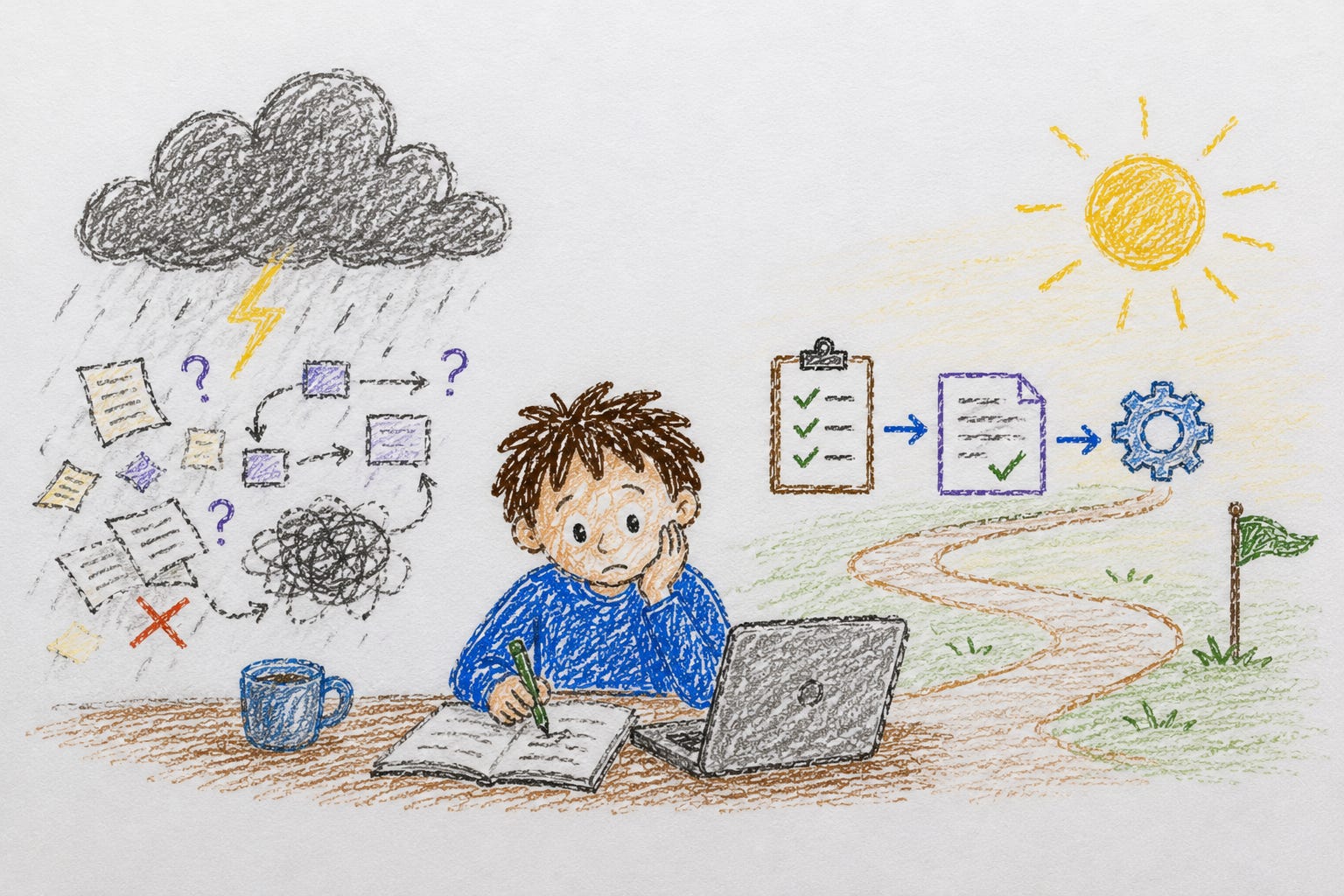
Why your process fails on the exact days you need it
You have paired with an AI coding assistant by now, so you know its two faces. For ten minutes it is the sharpest junior engineer you have ever worked with. Then it confidently does the wrong thing, because it guessed at something it should have asked you about, and you spend the next hour unwinding the guess. For a while I assumed the fix was a better model, or a cleverer prompt. It wasn’t.
The uncomfortable part is that I am no different. On a good morning I list my assumptions before I build on them, I poke holes in my own plan, and I read my diff before I push it. On a Friday afternoon, tired and behind, I skip all three. And the work that goes out on a Friday afternoon counts exactly as much as the work that goes out on a fresh Tuesday. A wrong assumption is patient. It doesn’t announce itself. It sits quietly and turns into a wrong step three commits later, when pulling it out is expensive.
So the quality of your work isn’t set by your best day. It is set by the version of you that shows up when you are drained, rushed, and would rather be done. That version is not going to summon extra willpower. Planning around the disciplined version of yourself is planning for someone who often isn’t there.
How to make good work survive a bad day

Stop keeping your process in your head, where it depends on you feeling sharp. Write it down as the path you are already on.
That is the whole idea behind a tool I published today: a folder of boring markdown files, claude-shipyard, which turns the software habits I would otherwise have to remember into commands that run themselves. When I start a task, one command drafts a plan and lists the assumptions at the top, because reading the assumptions first is the cheapest bug catching I do all day. When an idea is still fuzzy, another command interrogates me, opening with “why” and asking until the thing I hadn’t decided yet surfaces. Before I open a pull request, a third one reviews my own diff for the sloppiness I would be embarrassed by later. None of it is clever AI. It is years of ordinary practice written down as plain text, so the discipline stops depending on me being disciplined. The commands don’t have tired days.
You don’t need my commands, or an AI, to steal the move. Pick the one quality step you always drop when you are slammed. The pre-mortem before a launch. The “who did we actually talk to” before a roadmap call. The second look at a number before it goes in the deck. Then take it out of your memory and put it somewhere that will hold it for you: a checklist the tool won’t let you skip, a template with the step already filled in, a standing agenda item, a teammate whose job is to ask the annoying question. Anything but “I’ll remember.”
The version of you that has to run the step is tired and behind schedule. Build for that one.
Loud Camel news
Loud Camel, a tool that helps researchers get cited and recognized, runs on this exact idea. The visibility work a researcher means to do, post the preprint, fix the profile, email the people they cited, is precisely the work that loses to a busy semester, so Loud Camel turns those tactics into a system that runs on a schedule instead of on their memory. This week I tried to make it simpler to start: the entry plan dropped to $9.99, one run now costs a single credit instead of a tangle of “scans” and “credits,” and the posts it drafts for you finally live in a proper dashboard instead of scrolling off the screen. Fewer things to hold in your head is its own kind of tired-proofing.
Frequently Asked Question
If I only turn one visibility task into a system, which one?
Start with whether machines can find you at all. If your paper doesn’t surface when someone asks ChatGPT, Perplexity, or Google’s AI Overviews about your topic, it doesn’t exist for a growing share of the people who would have cited it, and no downstream tactic repairs that. Loud Camel runs that AI-search audit for you, alongside the profile hygiene and outreach steps from the same playbook, and it never sends anything on your behalf. It runs the check you keep meaning to run.
This Week on the Blog
Citation inequality is widening, which is why ‘above average’ isn’t the target Matching the field average still leaves most of your work invisible.
How AI Can Increase Academic Citations Where AI search actually moves your citation count, and where it doesn’t.
Best Research Distribution Platforms Compared A plain comparison of where to put a paper so people find it.
Why your biggest paper hasn’t happened yet The career math that says your best work is probably still ahead.
The Best AI Platform for Research Visibility What to check before you trust any visibility tool with your name.
Why Great Research Gets Ignored Online Good work isn’t enough; getting found is a separate job.
You mean to, and you won’t: the intention gap in research visibility The gap between planning to promote your work and actually doing it.
Takeaway This Week
Pick the one good-day habit you always skip when you are slammed, and this week move it out of your memory and into a default that runs without you.