

On professional losers
Skipping the status game is fine. Being impossible to find is a different decision, and you don't get to see who pays for it.
Opening
Last week I emailed a researcher I’d never met, to pitch them something. I’m building a tool called Loud Camel, the email was a cold pitch, and I expected either silence or a polite no. Instead I got a small gift. Over a couple of replies, this person described themselves as a “professional loser,” and they meant it with some pride. Then they sent me the 1973 paper where the insult was coined.
I’ve been chewing on it all week, because the argument underneath isn’t really about scientists. It’s about anyone who has ever decided that good work should speak for itself.
Here is what I want to argue. Refusing to play status games is healthy, and usually right. Refusing to be findable is a different decision. The two get mistaken for each other, and the second one carries a cost you almost never get to see.
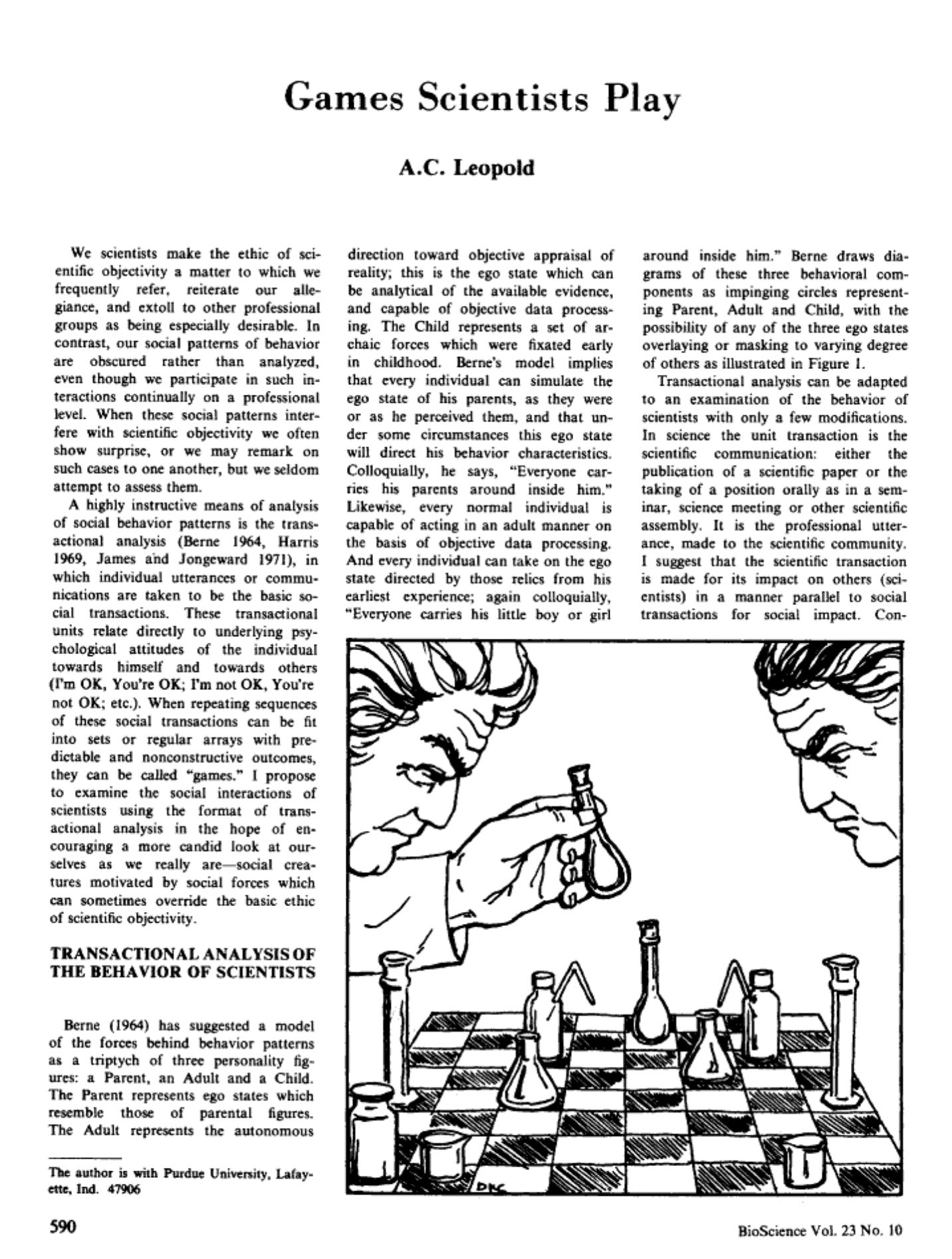
A 53-year-old insult
A. C. Leopold, a plant physiologist at Purdue, published “Games Scientists Play“ in BioScience in 1973. He borrows a then-fashionable bit of pop psychology (transactional analysis, the Parent / Adult / Child stuff) and uses it to describe the things scientists do that have nothing to do with science and everything to do with standing.
He names three games. Prestigious Scientist: chasing prizes, angling for society offices, publishing in a prestige journal even when, in his words, “most people who are interested in the subject of your paper may not read that journal.” I-Know-Best: the anonymous reviewer torching a rival’s paper because he can. Citation-Index: citing yourself as often as possible, then looking yourself up to check the score. My favorite is a smaller one, the drifting conversationalist at the conference, the person whose eyes scan the room over your shoulder for someone more important to talk to. You’ve met him. You didn’t admire him.
Leopold’s good point is that none of these moves “improve the substantive quality of the man’s science.” They are “specifically involved in altering his image in the eyes of his scientist peers.” Fine so far. Then he turns, and the turn is where the title comes from. A scientist who won’t compete, who publishes on “subjects of negligible interest” or spaces their work out “at excessively long intervals,” is, he writes, “tantamount to being a professional loser.” He thought an “alarming proportion” of trained scientists were exactly that, and it clearly annoyed him.
The professional loser has a point
The researcher who sent me the paper rejected Leopold’s framing flat. They called it “silly and testosterone-driven,” which it is. Their own position was calm and a little enviable: “I only care about what a few people think of my work and they are already aware of what I produce.”
And mostly, they’re right. Most of what we call self-promotion is Leopold’s status game wearing better clothes. The conference networker, the citation-counter, the person who runs their career as a personal brand. Opting out of that isn’t a character flaw. It’s good taste. If your reaction to the phrase “build your visibility” is a small flinch, the flinch is healthy.
So far the loser is winning the argument.
Two different things hide under “self-promotion”
Here’s where I split from them. Under that one word, “self-promotion,” sit two different activities that feel identical and aren’t.
One is status: changing your image in other people’s eyes. The other is findability: whether the person who needs your work can actually locate it. The status game is loud, optional, and a little gross. Findability is quiet, and increasingly it’s load-bearing.
When I pushed back in our exchange, the line I kept returning to was this: an occasional talk isn’t the same as making one finding discoverable, and almost nobody does the second thing on purpose. We collapse them into one word. So when someone sensibly swears off the first, they tend to skip the second too, as if both were the same act of vanity.
A short detour through the data, because I checked myself before writing this. The “loser” who refuses all engagement is rarer than Leopold feared. Pew found 98% of scientists interact with the public at least occasionally. The Royal Society’s 2006 survey and a 2020 census of US land-grant faculty, where 98.3% did at least one science-communication activity in a year, say the same. People engage. But buried in that same Pew survey: 77% of those scientists said promoting their findings on social media is not important for their career. They show up, and they still treat being findable as beneath the work. That gap is the whole subject.
Who actually pays
The thing about being unfindable is that the cost doesn’t land on you. You feel fine. Your work is good, you know it’s good, and the absence of a phone call is not a sensation.
It lands on the other person. The one who needed exactly what you figured out, didn’t find it, and built the worse version. For a PM, it’s the sharp decision you made last year that nobody can locate now, so the next team relearns it the slow way. For a founder, it’s the lesson you paid for in cash and sleep that someone down the road is about to pay for again. “The work speaks for itself” is only true when the work is in the room. A paper nobody can find isn’t judged on its merits. It just isn’t in the room.
Loud Camel news
This is the thing I was emailing a stranger about in the first place, so I’ll be quick. Loud Camel is what I’m building, and its whole job is that last sentence. Not making loud work louder. Reducing the rate at which good work gets missed. It takes a researcher’s actual papers and makes them findable by the people, and now the models, that would build on them. This week we shipped Content Studio, which writes in your own voice instead of the generic AI one and produces every format in a single run. That’s the ad. Back to the argument.
The catch I’d leave you with
The researcher might be completely right about themselves. If the few people who matter to your work already know it cold, you don’t need any of this, and the status games would only make you worse company. I believe them.
The trap isn’t their stance. It’s borrowing their stance without their situation. Most of us quietly assume the few people who matter already know our work, and we never check whether that’s still true. We decide the work will speak for itself, into a room we never confirmed was occupied.
So the question isn’t whether you promote yourself enough. It’s smaller and more uncomfortable: if the right person went looking, today, for the thing you know, would they find it? For most of us the honest answer is no. I might be wrong about how much that costs. I don’t think I am.